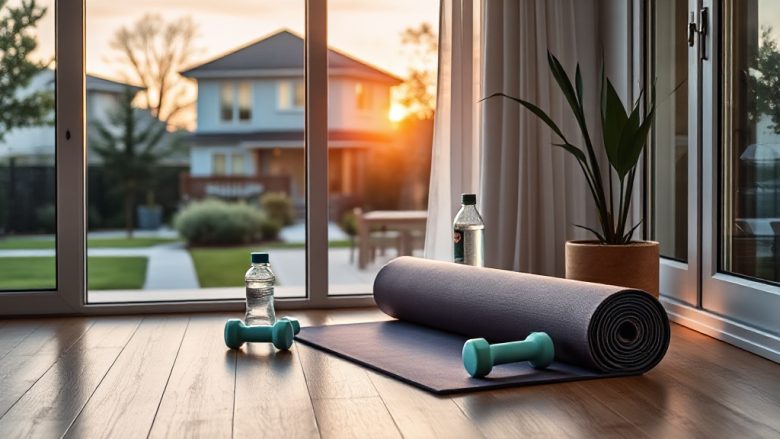
You have probably thought about exercising at home more than once. Maybe you’ve even opened a fitness app, watched a ten-minute video, and then closed it again because the person on screen had a full gym in their spare room. That’s not laziness. That’s confusion. Most people don’t fail to start because they lack willpower. They fail because nobody has told them what the first step actually looks like.
Learning how to get started with home workouts is less about motivation and more about removing four specific obstacles: space, equipment, time, and the mental fog that settles in when you’re standing in your living room unsure what to do. This article walks through each blocker with a workaround you can use today, no shopping trip required.
Blocker One: You Think You Don’t Have Enough Space
Almost nobody has a dedicated home gym. That’s fine, because you don’t need one. The space required for an effective workout is roughly the size of a yoga mat plus a little elbow room. If you can lie down on the floor and stretch your arms above your head without hitting furniture, you have enough room for a full session.
The trick is to claim a corner rather than a room. Pick a spot you walk past every day — beside the sofa, at the foot of the bed, in front of the window. Keep a rolled-up mat or a folded towel there so the space is already prepared. Decision fatigue is real. If setting up takes three minutes of moving chairs, you’ll skip it. If the mat is already down, you’ll use it.
Vertical space matters more than floor space for some movements. Before you assume a room is too small, test a few things. Can you raise your arms overhead? Can you step back into a lunge? Can you hinge at the hips without your backside hitting a wall? If the answer to those is yes, the room works. If not, clear one metre of floor and you’re done. Most people overestimate how much room a workout needs and underestimate how much room clutter takes up.
Blocker Two: You Don’t Have Equipment and Don’t Want to Buy Any
Equipment is the biggest source of unnecessary spending in home fitness. You do not need dumbbells, a bench, a resistance band set, or a subscription to start. Your body weight is a legitimate training tool, and it has been for a very long time. Push-ups, squats, lunges, planks, glute bridges, and step-ups onto a sturdy chair or stair will train every major muscle group.
If you do want to add resistance later, do it slowly and cheaply. A single resistance band costs very little and takes up almost no space. A pair of adjustable dumbbells is a bigger commitment and should only happen once you’ve proven to yourself that you’ll use them three times a week for a month. Buying gear before building the habit is how spare rooms end up full of unused equipment.
Household objects can fill gaps in the short term. A full water bottle works as a light weight. A backpack loaded with books becomes a decent substitute for a kettlebell for squats and rows. A sturdy chair is a bench, a step, and a support for split squats. None of this is glamorous, and that’s the point. The goal in the first month is consistency, not optimisation.
Blocker Three: You Genuinely Don’t Have Time
This is the blocker people feel most guilty about, and it’s usually the most solvable. The mistake is assuming a workout has to be forty-five minutes to count. It doesn’t. A focused fifteen-minute session done three times a week will build strength and stamina in a beginner, especially in the first two months when progress comes quickly.
What matters is that the time is protected, not that it’s long. Fifteen minutes is short enough to fit before a shower, during a lunch break, or while dinner is in the oven. The problem with waiting for a free hour is that the free hour never arrives. It gets eaten by messages, chores, and the quiet temptation to sit down.
Try anchoring the workout to something you already do every day. After you make your morning coffee, before you open your laptop, or right after you put the kids to bed. An anchor turns a vague intention into a routine. You’re not finding time; you’re attaching exercise to time that already exists.
If your week is genuinely chaotic, aim for two sessions and treat a third as a bonus. Two short sessions done reliably beat five planned sessions that never happen. Consistency in small doses is what builds the habit, and the habit is what makes everything else easier later.
Blocker Four: You Don’t Know What to Actually Do
This is the real reason most people stall. They stand in the living room, open an app, see fifty workout options, and close it again. Too much choice is worse than no choice. The fix is to stop browsing and start with one simple routine you repeat until it feels easy.
Here is a starter session that needs no equipment and fits in a small space. Do each movement for forty seconds, rest for twenty, and go through the list twice. That’s roughly fifteen minutes including warm-up.
- March in place or jog on the spot to warm up
- Bodyweight squats, sitting back as if into a chair
- Push-ups, on your knees or against a wall if needed
- Reverse lunges, alternating legs
- Glute bridges, lying on your back with feet flat
- Plank hold, on knees if your lower back complains
That’s it. Six movements, no equipment, no noise, no jumping. Do it on Monday, Wednesday, and Friday for two weeks. On the third week, add a third round or slow the movements down. Progress comes from doing the same thing slightly better, not from constantly switching routines.
If you want a second session for variety, swap the plank for a dead bug and the lunges for step-ups onto a bottom stair. Keep the structure identical. Familiarity reduces the mental load of starting, and reducing that load is the whole game.
Blocker Five: Motivation Fades, So Build Around It
Motivation is unreliable. It shows up when you’re rested and disappears when you’re stressed, which is exactly when a workout would help most. Don’t build your plan on it. Build on friction instead. Make the good choice the easy one and the bad choice slightly harder.
Leave your mat out. Sleep in your workout clothes if that helps. Put your phone in another room during the session so the scroll isn’t within reach. These are small adjustments, but they change the default. When the mat is already on the floor, the gap between thinking about exercising and actually doing it shrinks to almost nothing.
Track something simple. Not your weight, which fluctuates and lies to you, but whether you showed up. A tick on a calendar is enough. Seeing a run of marks builds a quiet momentum that motivation can’t match. Miss a day? Don’t double up to make up for it. Just tick the next one. The goal is a pattern, not a perfect record.
Expect the first two weeks to feel awkward. Your coordination will be clumsy, your muscles will complain, and you’ll wonder whether it’s working. That’s normal and it passes. By week three, the same routine starts to feel smoother, and by week six, you’ll notice stairs are easier and carrying shopping is less of a chore. Those small wins are the real reward, and they arrive faster than most people expect.
Starting at home isn’t about having the perfect setup. It’s about lowering the barrier until the first step is small enough that you’ll actually take it. Clear a metre of floor, skip the equipment, protect fifteen minutes, and repeat one simple routine until it stops feeling new. That’s how it starts. Everything else is refinement, and refinement can wait.